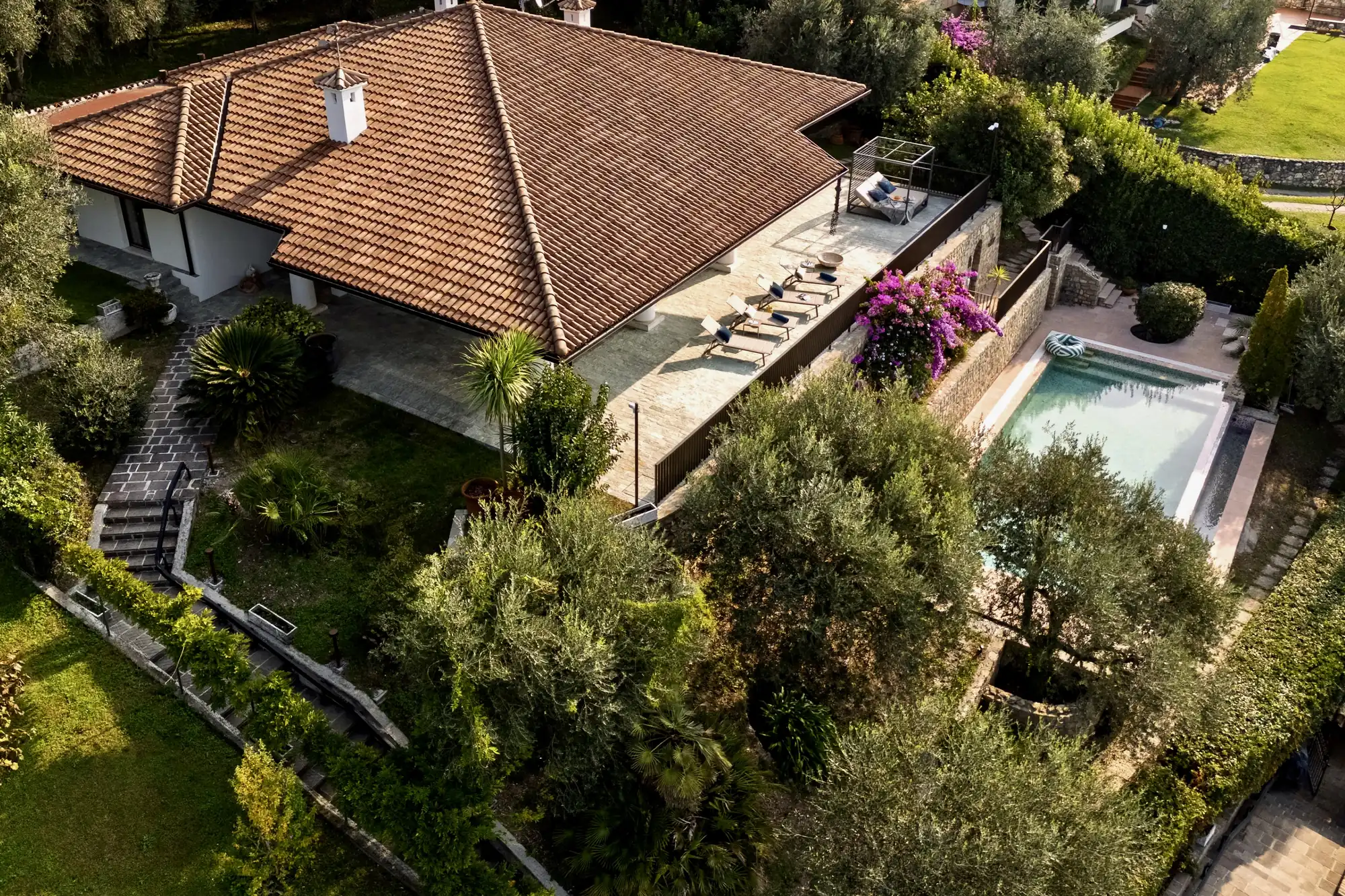
Some places announce themselves. Gargnano never needed to. Halfway up the western shore of Lake Garda, between Salò and Limone, it sits with its back to the mountains and its face to the water: a small harbor, a lakeside promenade, a few streets of pastel houses. For generations, those who knew it simply kept coming back.
The harbor and the old village
The heart of Gargnano is its little port, where fishing boats and sailing yachts share the water and the cafés set out their tables at the edge of the lake. A walk along the lakefront promenade leads past historic houses and gardens, with the slopes of Monte Baldo across the water on the opposite shore.
Step back from the lake and you'll find the church of San Francesco, whose medieval cloister is one of the village's quiet treasures. Look closely at the carved capitals of its columns: lemons and oranges appear among the stone leaves, a reminder of what once made this shore wealthy.
Villas and palazzi
Gargnano's elegance comes from the families who built here. Along the shore stand aristocratic residences such as Palazzo Feltrinelli, built for the industrialist family of the same name, and, in the neighboring hamlet of Bogliaco, the baroque Villa Bettoni with its terraced gardens. Together with the villas scattered through the olive groves above the village, they give Gargnano its distinctly refined character.
The lemon houses
From the water, you'll notice tall stone pillars rising in rows on the terraced slopes. These are the remains of the limonaie, the lemon houses. From the 17th to the 19th centuries, the western shore of Garda was Europe's northernmost lemon-growing region: in winter, the pillars were covered with wooden roofs and glass panels to protect the trees from the cold. Some have been restored, and they remain one of the most characteristic sights of the area.
On the water
Gargnano has a long sailing tradition. Every late summer, the hamlet of Bogliaco hosts the Centomiglia, one of the oldest and most prestigious sailing regattas on any lake in Europe, and the shore fills with sails.
For guests, the lake is best enjoyed simply: a swim from one of the pebble beaches (the nearest is about 700 meters from Villa Giulia), a private boat for an afternoon along the cliffs to Limone, or a ferry across the lake to Malcesine for lunch and the cable car up Monte Baldo.
Into the hills
Behind the village rises the Alto Garda Bresciano nature park, a landscape of olive groves, chestnut woods and high plateaus. Footpaths lead up to the hamlet of Muslone, with wide views over the lake, and beyond to the villages of Tignale and Tremosine, perched on the cliffs high above the water. Further inland, the Valvestino lake hides in a green valley that few visitors ever reach.
At the table
The western shore is known for its olive oil, among the northernmost in the world, and for lake fish such as lavaret (coregone), trout and the small lake sardines, often served simply grilled or with polenta. Pair them with a glass of Chiaretto, the pale rosé from the nearby Valtènesi hills.
For its size, Gargnano has an unusual concentration of fine dining. Several of the lake's most celebrated restaurants are within walking distance of Villa Giulia, alongside simple trattorias where lunch on the water stretches into the afternoon.
A writer's village
In 1912, the English writer D.H. Lawrence spent a winter in Gargnano, and the village and its people found their way into his travel writing about Italy. More than a century later, the qualities he found here (the light, the quiet, the sense of a life lived at its own pace) are still what draws people to this shore.
← All journal entries